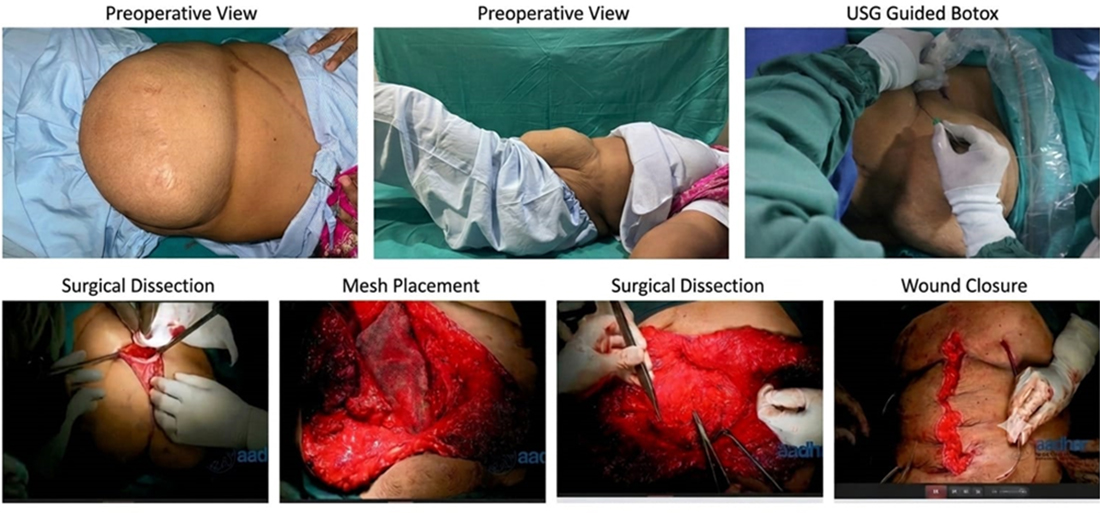
Management of Massive Ventral Hernia with loss of domain utilizing preoperative botulinum toxin A (Botox)
Executive Summary
This clinical report outlines the successful multidisciplinary surgical management of a complex, high-risk massive ventral hernia with Loss of Domain (LOD) performed at Aadhar Health Institute. By incorporating preoperative Botulinum Toxin A (Botox) chemical component relaxation into the anterior abdominal wall musculature, our surgical team achieved tension-free fascial closure, restored abdominal wall integrity, and mitigated the risk of postoperative abdominal compartment syndrome.
Patient Demographics & Clinical Presentation
|
Age / Gender: |
48-year-old Female |
|
Anthropometrics: |
Height: 155 cm | Weight: 72 kg | BMI: 30.0 kg/m² (Class I Obesity) |
|
Chief Complaint: |
Large swelling over anterior abdominal wall for past 3 years, gradually increasing in size. |
|
Clinical Features: |
Swelling increases significantly on standing/exertion and reduces partially on lying supine. |
Past Surgical & Medical History
- 2016: Open Umbilical Hernioplasty
- 2022: Open Cholecystectomy
- 2025: Laparoscopic Sleeve Gastrectomy
- 01/06/2026: Injection Botulinum Toxin A (Botox) 300 Units administered intramuscularly into anterior abdominal wall to induce chemical flaccid paralysis and lateral compliance.
- Medical History: No significant co-morbid medical conditions reported.
Diagnostic Evaluation & Volumetric Analysis
|
Parameters / Imaging |
NCCT Abdomen (25/05/2026) |
NCCT Abdomen (25/07/2026) |
|
Defect Location & Size |
7.0 x 6.4 cm defect in Linea Alba |
7.1 x 6.5 cm defect in Linea Alba |
|
Hernia Contents & Volume |
Small & Large bowel loops + mesentery |
Small & Large bowel loops + mesentery |
|
Abdominal Cavity & Loss of Domain |
Cavity Volume: 3722 cc |
Cavity Volume: 3774 cc |
Upper GI Endoscopy (25/05/2026): Demonstrated status post-sleeve gastrectomy, lax gastroesophageal junction (GEJ), and multiple gastric ulcers. Medical therapy was optimized prior to elective surgical intervention.
Surgical Strategy & Clinical Takeaways
- Preoperative Chemical Component Relaxation: Injection of 300 Units of Botox into the lateral abdominal wall muscles (External Oblique, Internal Oblique, and Transversus Abdominis) successfully achieved muscular flaccidity, significantly increasing lateral compliance.
- Tension-Free Abdominal Wall Reconstruction (AWR): Despite a significant hernia sac volume (1518 cc) and Loss of Domain (~28.6%), chemical paralysis facilitated the reduction of contents and primary fascial closure reinforced with mesh.
- Prevention of Abdominal Compartment Syndrome: Preoperative muscle expansion prevented post-reduction intra-abdominal hypertension, maintaining normal ventilation parameters and visceral perfusion.
Clinical Image Gallery & Diagnostic Media
The designated placeholder frames below are provided for inserting high-resolution clinical documentation and intraoperative surgical records for the hospital website gallery.